QUESTION:
Analyse the way that Media Language is used to present social contexts in Source A (The Daily Mail) and Source B (The Guardian Online).
Apply Barthes Theories about Semiotics in your answer.
CONTEXT
The Nottingham maternity scandal centred on serious failures in maternity care at Nottingham University Hospitals NHS Trust, where hundreds of babies and mothers died or suffered avoidable harm. A major review published in June 2026 found evidence of a “toxic” institutional culture, including concerns that women’s experiences and warnings were not properly listened to. The story prompted wider debate about women’s healthcare, institutional accountability, gender inequality and whether NHS systems adequately listen to and protect mothers and babies.
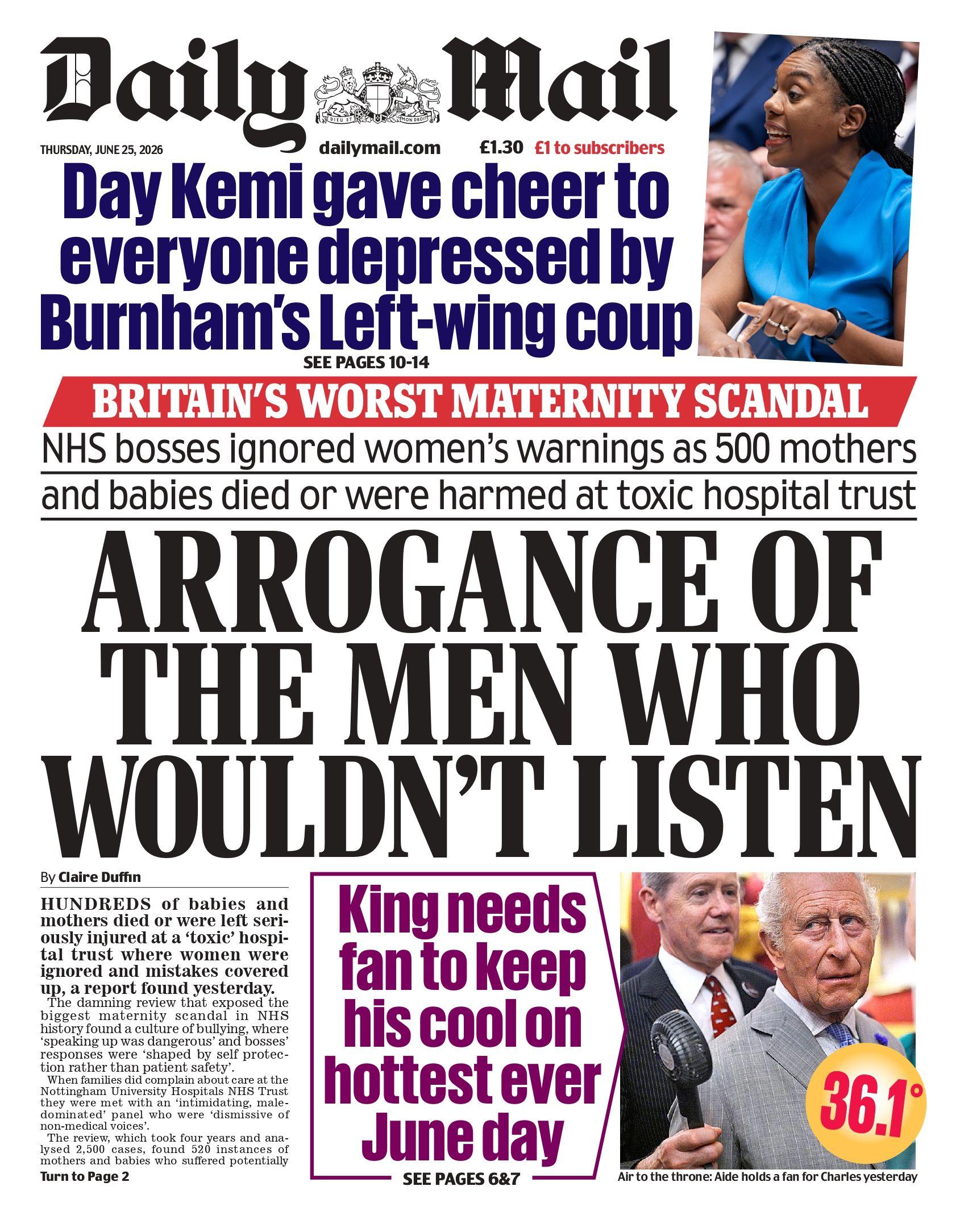
SOURCE A: The Daily Mail Front Cover (Right Wing)
https://hermes.media.static.aol.com/media/2026/06/25/a125da6a-abfd-3dad-af27-27d6084acb90/168a8572-b4d2-4a76-a8da-614215f22cb8.jpg

SOURCE A: The Daily Mirror Front Cover (Left Wing)

SAMPLE ESSAY
Barthes theorises that signs are used to construct connotations connected to social and cultural myths. He argues that these myths make ideologies seem natural and reinforce social and cultural norms.
The social context constructed by the Daily Mail cover addresses the myth of male power and perhaps attempts to undermine the cultural myth of the NHS as a deeply caring institution. The banner headline is bold and damning in its portrayal of men as a social group, stating clearly that male “arrogance” and a refusal to “listen” is at the heart of the scandal that led to the death or harm of “500 mothers and babies.” At first, we might see this as challenging the right wing patriarchal ideological position of the Daily Mail, but it is notable that the headline still centralises male authority; it reinforces the myth that men as a social group have power over women and children, which naturalises patriarchal authority, despite being critical of men as a social group. The typography, using capitals and a serif font reinforces the traditionalist stance of the newspaper, further lending itself to the idea that it tacitly traditional values of male hierarchy and control. Interestingly, the Daily Mail has chosen not to use an image associated with this lead story. This may be because they didn’t want to create sympathy for the female victims, but it is more likely to reinforce their criticism of the left-wing institution (NHS). The connotation of having no image of people involved reinforces the idea that the NHS are faceless and don’t care for the weakest social groups, mothers and babies. This naturalises the right-wing ideological position of the paper.
The Daily Mirror frames the story in a far more humane way, within the social context of family and couples rather than patriarchal control. It constructs the myth of family but also of governmental power to improve in the face of disaster. Unlike the Daily Mail, the Mirror selects an image of a bereaved couple. The vignette effect and the choice of facial expression and body language construct a sense of their grief. The proxemics places Sarah in the front of the image, perhaps to construct the sign that women suffer the greatest loss when a child dies. However, her husband is also shown to be grieving, which negates the patriarchal values seen in the Daily Mail, creating a more collectivist and egalitarian approach to the story, which will naturalise the more progressive values of the Mirror’s left-wing readership. The headline, “Never Again,” is bold and sans serif, connoting the seriousness and strength of the sentiment; moreover, the white on black is stark and may connote the sense that there is only one way to see the situation. Unlike the Daily Mail, which accused a toxic culture within the NHS, The Mirror constructs a more positive position by presenting a promise by Health Secretary using the powerfully emphatic word “pledge.” This actively supports a culture of change and constructs the cultural myth that the NHS is an important institution that the government must support rather than condemn.

Daniel Patrick,
ReplyDeleteBarthes argues that signs create connotations which can construct myths, that make ideologies appear naturally us. This can link to social context by reinforcing our expectations about different social groups.
Lewis Martin
ReplyDeleteBarthes theorises that signs and signifiers create connotations that construct social myths. These myths force us to believe in some ideologies and see them as normal.
Barthes theories that connotations can by constructed by the use of signs, which then connect to social myths. His argument is that myths naturalise ideologies and reinforce norms in society.
ReplyDeleteSonny Johnson
ReplyDeleteBarthes theorises that signs create connotations which construct myths. Arguing that myths make ideologies seem natural and reinforce social norms.
katie B-
ReplyDeleteBarthes theory of semiology is the study of signs that are used to connotate social context through myths and ideologies. These signs are created from a signifier and a signified that make the ideology seem natural and reinforces social norms.
In the theory of Barth, he says that signs are used to construct connotations related to social media and cultural myths. In the Theory, Barth argues that, the myths that are created end up reinforcing social and cultural norms and making ideologies seem natural.
ReplyDeleteRufus
ReplyDeleteBarthes theory of semiotics states that all signs in media texts have a signifier, and a signified meaning. These signifiers construct social myths that we as a society conclude to be the 'norm'.
Erin
ReplyDeleteBarthes theories shows us signs that are used in source A (right wing) and source B (left wing). This argues how social myth makes ideology seem more natural in different social groups.
Daisy-
ReplyDeleteBarthes media theory is about semiology, he uses his theory to connect to social myths by using signs, signifiers and signified. He also uses connotations and denotations to make his ideologies seem natural.
rosie ansell - halford: Barthes argues that signs create connotations which can construct myths that make ideologies seem natural. This links to social context by emphasizing over expectations about different social groups.
ReplyDeleteEvie Pidduck- Barthes theorises that signs create connotations which reinforce social myths. He argues myths make ideologies appear natural which embeds norms in society.
ReplyDelete- Nadia C
ReplyDeleteRoland Barthes uses social contexts to presents his theory of semiotics. Semiology is the study of signs. Barthes suggests that media has a denotative meaning and a connotative meaning. The denotative meaning recognises the literal meaning, whilst the connotative meaning diagnoses the deeper symbolic meaning. Barthes theory constructs social myths which makes ideologies seem natural.
Barthes theorises that signs consist of a signifier and can create connotations and can then make ideologies seem natural. This links to social context and can reinforce our ideas about certain social groups.
ReplyDeleteBarthes theory about semiotics states that signs and signifiers create denotations and connotations, which can be used to construct cultural myths. He argues that myths challenge societal norms, making ideologies appear natural.
ReplyDeleteHolly Adams
ReplyDeleteBarthes theorises that signs consist of a signifier and can create connotations and can then make ideologies seem natural. This links to social context and can reinforce our ideas about certain social groups.
Barthes theorizes that signs create connotations that construct myths, making ideologies appear natural or common sense, linking to social context by using those myths in different social groups
ReplyDeleteBarthes Theory states that media texts communicate meaning trough signs of a signifier and a signified.
ReplyDeleteLewis Martin
ReplyDeleteTheory: 1/2
Question: 1/2
Examples: 2/2
Analysis: 2/2
Terminology: 1/2
Total: 7/10
Remove cultural from the essay and it would be better because cultural isn't answering question. But the analysis is still good and the examples are plentiful.
Sonny Johnson
ReplyDeleteTheory - 1
Question - 1
Examples - 2
Analysis - 2
Terminology - 1
7/10
Strays from the question at times and occasionally uses vague language rather than specific terminology.
Holly Adams
ReplyDeleteTheory 1/2
Question 2/2
Examples 2/2
Analysis 2/2
Terminology 2/2
9/10
Use correct terminology when characterising Barthes' theory.
rosie ansell - halford
ReplyDeletetheory 1/2
question 2/2
example 2/2
analysis 2/2
terminology 2/2
9/10 good analysis and but could use more theory and terminology when it comes to barthes theory
DeleteEvie Pidduck-
ReplyDeleteTheory-(1)
Question-(2)
Example-(2)
Analysis-(2)
Terminology-(2)
Be more specific when defining Barthes terminology
Delete- Nadia C
ReplyDeleteTheory- 1
Question- 1
Example- 2
Analysis- 2
Terminology-2
8/10 -> The answer would be better if it had more of Barthes' theory.
Rufus
ReplyDelete2/2
2/2
2/2
1/2
2/2
overall - 9/10 - The theory is correctly characterised , with specific detailed examples. media studies terminology is good, but there could be more detail on theory.
katie b-
ReplyDelete1)1/2
2)2/2
3)2/2
4)1/2
5)1/2
7/10 the answer could be better if it had a better opening to the theory more us of media terminology and theory
Erin
ReplyDelete1. THEORY - 1/2
2. QUESTION - 1/2
3. EXAMPLE - 2/2
4. ANALYSIS - 1/2
5. TERMINOLOGY - 1/2
Total - 6/10
Removing cultural context would be better since the question is only asking about social context.
theory 1
ReplyDeletequestion 2
example 2
analysis 2
terminology 2
could use more theory
theory - 1
ReplyDeletequestion - 1
example - 2
analysis - 2
terminology - 2
theory - 2/2
ReplyDeleteexample - 1/2
analysis - 2/2
terminology - 1/2
question - 2/2
overall, well written and detailed.
could add another example to link back to question - helping support answer. Also add more about Barthes theory and how it is used in the source.
Theory - 2
ReplyDeleteQuestion - 1
Example - 2
Analysis - 2
Terminology - 2
8.7/10 - good analysis and theory, but the question wasn't clearly answered.
Arthur
ReplyDelete1/2
1/2
2/2
2/2
2/2
7/10