Showing posts with label - P1. NEWS - QUESTION 1. Show all posts

Saturday, 11 April 2026

TRENDS: QUESTION 1

2019: Sources: Daily Mail Front Cover + Daily Mirror Cover

Question: Social and Cultural Representation + Hall

2020: Sources: Daily Telegraph Cover + Guardian Website

Question: Social Representation + Gilroy

2021: Sources: The Sun Website + The Guardian Website

Question: Political Context + Levi Strauss

2022: Sources: Daily Mail Front Cover + Daily Mirror Cover

Question: Historical Context + Gilroy

2023: Sources: Daily Mirror Facebook Feed + Daily Express Facebook Feed

Question: Political Contexts + Barthes

2024: Sources: Mirror Front Cover + Daily Mail Front Cover

Question: Social Contexts + Bell Hooks

2025: Sources: Guardian Twitter Page + Daily Telegraph Twitter Page

Question: Political Contexts + Barthes


2026 Sources?

  • Comparison of Online and Cover  has not been used since 2021
  • Comparison of Two Covers is likely compared to 2025
  • Comparison of two social media pages is unlikely as it was done in 2025. 

2026 Theorists?

  • The trend is switch each year between Language and Representation. 
  • This year SHOULD be representation, but don't rely on it. 

2026 Context?

  • The trend is to switch between political and social but it is not a solid trend. 
  • 2025 focused on political context, so expect social, cultural or historical.
  • However, 2024 (the source year) featured a general election. 


Tuesday, 31 March 2026

Applying Theorists - Revision Number 1

EITHER: 

Media Language Questions

Analyse the way that Media Language is used to present social and cultural contexts in Source A (The Daily Mail) and Source B (The Guardian Online).​

  • Apply Barthes Theories about Semiotics in your answer.
  • Apply Levi-Strauss theories about structuralism in your answer.
  • Apply Todorov's theories about narratology in your answer.
  • Apply Baudrillard's theories about Postmodernism.
  • Apply Neale's theories about genre.
NB: Contexts can be social, cultural, political or historical.

Media Representations Questions

Analyse the different social and cultural representations in Source A (The Daily Mail) and Source B (The Guardian Online).​
  • Apply Hall's theories on representation in your answer. ***
  • Apply Van Zoonen's theories on Feminist Representations in your answer. ***
  • Apply Gilroy's Post-Colonial Theory in your answer.
  • Apply bell hook's theories on Intersectionality in your answer.
  • Apply Gauntlett's theories on Identity in your answer.
  • Apply Butler's theories on Gender Performativity. 
NB: Representations can be social, cultural, political or historical.

QUESTION CONTEXT: 

On March 7th, 2021, Meghan Duchess of Sussex gave an Interview to Oprah Winfrey in which she accused the Royal Family of racism. This came just a few hours after the Queen's speech to the British Commonwealth in which she stressed the importance of duty.

 SOURCE A: DAILY MAILCOVER MARCH 8th 2021

SOURCE B: THE GUARDIAN ONLINE MARCH 8th 2021


MEDIA LANGUAGE THEORISTS

Barthes theorises that meaning is communicated through signs, whereby the relationship between the signifier and the signified produces connotations that audiences read as natural and inevitable. He argues that these connotations function as myths, naturalising dominant values and ideologies by making socially constructed meanings appear to be simply common sense.

Lévi-Strauss theorises that narratives are structured around binary oppositions: pairs of conflicting forces such as good and evil, powerful and powerless, old and young etc. He argues that by identifying which side of each opposition is presented as dominant, it is possible to uncover the ideological messages and values that a text implicitly endorses or normalises.

Todorov theorises that narratives move through three distinct stages: an initial equilibrium representing everyday normality, a disruption to that equilibrium, and a resolution that establishes a new order. He argues that analysing what a narrative presents as normal and how it chooses to resolve conflict reveals the underlying values and ideological messages it communicates to its audience.

Baudrillard theorises that in contemporary culture, representations have become more powerful than reality itself; he calls this he calls hyperreality. He argues that media texts no longer reflect the real world but instead reference other representations, creating a system of signs that communicates ideology whilst concealing the fact that it has lost all connection to reality.

Neale theorises that genre is produced through the repetition of codes and conventions across media texts, and that audience expectations are shaped not only by the texts themselves but by marketing, reviews, and other forms of intertextual relay. He argues that genres are not fixed but evolve as producers subvert conventions or blend genres together in a process of hybridisation.


MEDIA REPRESENTATION THEORISTS

Hall theorises that Media producers attempt to fix a preferred meaning by manipulating what is present, what is absent, and what is different. He argues that these representations often reinforce dominant ideologies (hegemony) through the use of stereotypes and selective framing guiding audiences to accept certain values and beliefs or viewpoints and ideologies. 

Van Zoonen theorises that media representations of women in patriarchal cultures rely on objectification, positioning women as objects of a male gaze rather than as subjects in their own right. Conversely, men are positioned as active subjects, shaping their environment. She argues that gender is socially and culturally constructed, meaning that newspapers both reflect and reinforce dominant ideological assumptions about gender roles, consistently serving patriarchal power structures.

Gilroy theorises that the legacy of colonialism continues to shape attitudes towards ethnicity in western societies, sustaining an assumption of white cultural superiority. He argues that media representations often reflect this postcolonial ideology by addressing a predominantly white audience and marginalising or rendering invisible the experiences of other ethnic groups.

hooks theorises that media representations actively reinforce a system of interlocking oppressions. Through her concept of intersectionality, she argues that gender, race, class, sexuality and disability interact within representation to reinforce a white supremacist capitalist patriarchal system, making structural inequality appear natural and inevitable.

Gauntlett theorises that media representations offer audiences a wide and often contradictory range of messages about identity, which audiences actively draw upon to explore and construct their own sense of self. He argues that identities, particularly those of gender and sexuality, are no longer seen as fixed, and that media plays a key role in reflecting and enabling this fluidity.

Butler theorises that gender identity is not something we are born with but something produced through the repeated performance of socially learned behaviours. She argues that by presenting certain performances of gender as natural and inevitable, media texts reinforce normative gender roles, whilst representations that deviate from those norms (she calls this calls gender trouble expose) the constructed and unstable nature of gender identity itself.

Monday, 1 September 2025

NEWSPAPERS - QUESTION 1 MARK SCHEME

USE THE FOLLOWING MARK SCHEME TO HELP STRUCTURE YOUR RESPONSES TO THE UNSEEN QUESTION AT THE START OF PAPER ONE.

1. Correctly characterise the theory [0,1,2]​ 

Your first paragraph should be two or three sentences long. It should correctly describe the theory.

2. Answer the question [0,1,2]​  

Every question has a core. In your answer you should carefully address that core and use the same language in your answer.

For Example,

Question: Analyse the different social representations in Source A and Source B. 

In the answer to this question you should analyse the different social representations and make it clear that you are doing that by using the phrase 'social representations' repeatedly.

Question: Analyse the way that Media Language is used to present social and cultural contexts in Source A (The Daily Mail) and Source B (The Guardian Online).​

In the answer to this question you should analyse the presentation of  social and cultural contexts and make it clear that you are doing that by using the phrase 'social and cultural contexts' repeatedly.

3. Use specific and detailed examples [0,1,2]​ 

Carefully select examples from the text to write about. There may be times when you approach it slightly differently, but as a rule of thumbs approach in this order:

i) Look at the main image and anchoring text.

ii) Look at the main headline and sub headline - consider typography and language

iii) Look at anything else of interest on the page

4. Uses the theory to analyse the examples [0,1,2]​

After you have presented the example, apply the theory to analyse it.

5. Use Media Studies terminology [0,1,2]

Finally, and throughout, try to use as much terminology that is specific to Media Studies as you are able. (You'll get better at this as you progress).


1. THEORY [0,1,2]​   

2. QUESTION [0,1,2]​ 

3. EXAMPLE [0,1,2]​   

4. ANALYSIS  [0,1,2]​

5. TERMINOLOGY [0,1,2]

Sunday, 31 August 2025

NEWSPAPERS: HALL

Question
Analyse the social representations in Source A and Source B. 
Apply Hall's theories about representation in your answer.

1st. Review the markscheme for this type of question.
- What phrase from the question are you going to repeat in your answer?
- What does this phrase actually mean?

2nd. Review the markscheme again. 
- What is the first thing you are going to write about in your answer?

3rd. Use the points below to help you write the first paragraph. Try to be succinct.
- Post your paragraph in the comments section below.
  • Hall points out that there is no 'true' meaning, but that a representation can generate many meanings.
  • Hall theorises that meaning is constituted by what is present, what is absent and what is different. 
  • Hall implicates the audience in creating meaning. 
  • Hall explains that power (hegemony) tries to 'fix' a preferred meaning through stereotyping.

SOURCE A: The Guardian - November 25th 2021


SOURCE B: The Daily Express - November 25th 2021


Source A:
Image: In the foreground, there is a representation of a woman carrying one child and holding another. Her body language and facial expression have been selected to show her extreme fatigue. Behind her the British border force can be seen, but they are turned away, so remain faceless. At least two men are visible in the background, but the image does not dwell on them.

Anchoring Text: The anchoring text reads: A mother helps her children onto the beach at Dungeness after being rescued in the channel yesterday.

Paragraph:
The Guardian encode a message of support for the refugees. The social representation of a "mother" and "her children" is established by the anchoring text, which denotes that the woman that is present in the foreground of the image is the mother of the two children that she is carrying and holding hands with. The selected image constructs a stereotypical representation of a migrant woman as being fatigued by her journey, and the word "rescued" attempts to fix a preferred meaning that she (and women like her) need help and support from the UK authorities. The social representation in the image includes two males who also seems to be migrants, but they are absent from the centre of the image which contributes to the Guardian's attempt to stereotype refugees as being women and children. This  is different to the hegemonic social representation of small boat migrants as 'fighting age men' which is often shown in the right wing press, and conforms to the Guardian's left wing messaging. 


Wednesday, 7 May 2025

UNSEEN ANALYSING: GLOSSARY (PART THREE)

Glossary for Analysing a British Newspaper Front Cover

Masthead

The newspaper’s title/logo at the top of the front page; key to brand identity (e.g. The Guardian, The Sun).

Headline

The large, bold title of the lead story; grabs attention and sets the tone.

Standfirst

A short introductory sentence or paragraph under the headline; offers a summary or tease.

Byline

Name of the journalist who wrote the article, sometimes with location or job title.

Dateline

The publication date, usually near the masthead.

Main Image / Lead Image

The dominant photograph or graphic, often supporting the splash story.

Caption

Brief explanation under or near an image, identifying people, context or linking to the story.

Splash

The main story on the front page; typically paired with the largest headline and image.

Secondary/Off Lead

An additional story on the front page, usually smaller in scale than the splash.

Puff

A visual device (often in a coloured box or shape) that promotes extra content like features or exclusives.

Banner

A strip across the top or bottom of the page highlighting key content or offers.

Strapline

A short phrase above or below the headline offering more detail.

Teasers / Promos

Smaller headlines or images encouraging readers to turn to inside pages.

Pull Quote

A quote from the article enlarged on the front page for emphasis.

Typography

Use of font styles and sizes to create hierarchy, identity and tone.

Colour Palette

The specific colours used to reflect branding or tone (e.g., red for urgency, blue for authority).

Price and Barcode

Commercial details often found near the masthead or bottom corner.

Layout

Arrangement of all elements on the page; varies by format (e.g., tabloid vs. broadsheet).

Mode of Address

The way the newspaper speaks to its readers—can be formal, informal, sensational, etc.


Glossary for Analysing Articles on a British Newspaper Website

Headline

A bold, attention-grabbing title; often adapted for search engines and social media.

Standfirst

Introductory sentence or paragraph summarising the article before the main body.

Byline

Author’s name, typically at the top, sometimes with links to more of their work.

Timestamp / Dateline

Shows when the article was published or updated; signals timeliness.

Lead Paragraph

The opening paragraph giving the key facts (who, what, when, where, why, how).

Inverted Pyramid

News structure where the most important info appears first, with details following in order of decreasing importance.

Hyperlink

Clickable text linking to related articles, sources, or external content.

Embedded Media

Videos, images, infographics or audio placed within the article to enhance meaning or engagement.

Pull Quote

Highlighted quote from the article, often visually separated to draw the reader’s eye.

Related Articles

A list of suggested content, often shown in a sidebar or at the end of the article.

Social Sharing Icons

Buttons that allow readers to share content via platforms like X (Twitter), Facebook, or WhatsApp.

Comments Section

Reader responses to the article, sometimes moderated or limited to subscribers.

Advertisement / Sponsored Content

Commercial content embedded within the article or page; may appear in banners, sidebars or pop-ups.

Paywall

A subscription model that limits access to full articles unless the reader pays or registers.

Cookie Banner

A notice requesting permission to track user data for legal compliance (UK GDPR laws).

Navigation Bar / Menu

The menu at the top or side of the site allowing users to find sections (e.g., News, Sport, Opinion).

Tone

The article’s voice—can be neutral, critical, humorous, formal, etc.

Bias

A perceived slant in the article’s reporting or perspective—may be political, cultural or ideological.

House Style

The consistent writing and formatting style followed by a particular publication (e.g., The Times vs. The Mirror).

Accessibility Features

Design choices like alt text, readable fonts or captioned videos that ensure access for all users.

Friday, 14 March 2025

QUESTION 1: PAST PAPER 2020

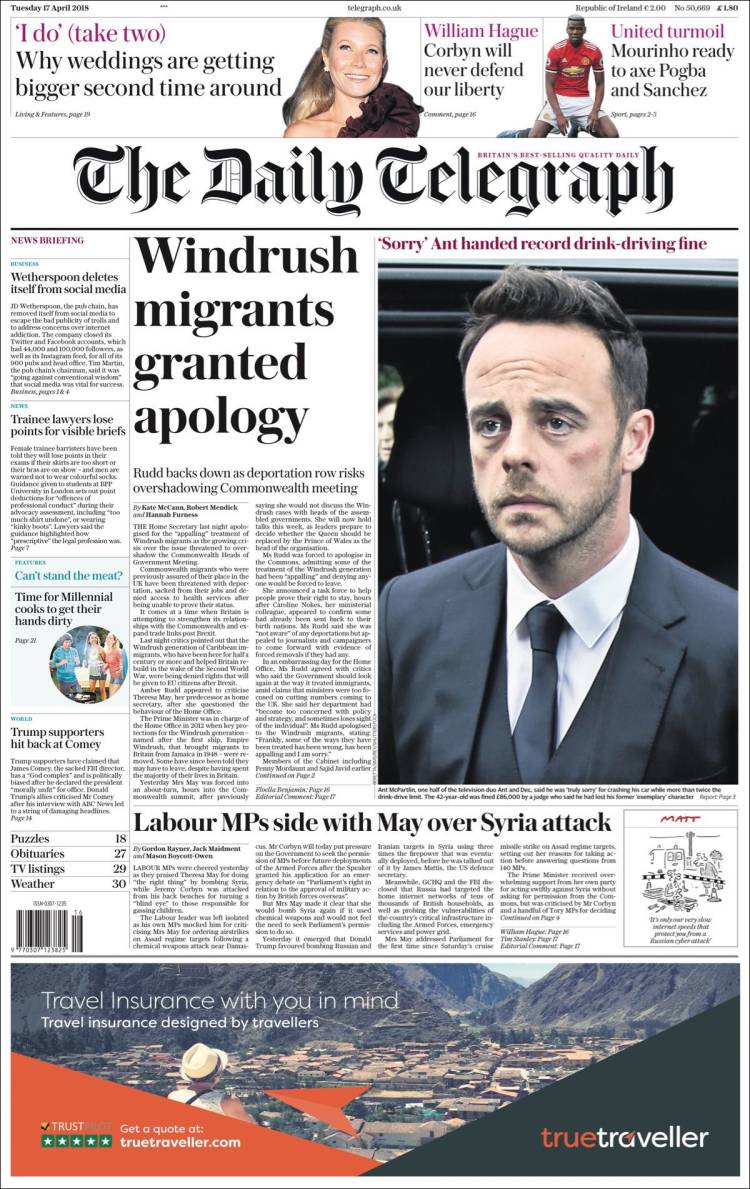
Study Sources A and B. The main story in both sources is about a group of immigrants who arrived in the UK in the 1950s from the Caribbean. They are known as the ‘Windrush generation’. The migrants were led to believe that they had been given UK citizenship at the time. In 2010, after the election of a new government, which was more hostile to immigrants, many of the Windrush migrants were deported (sent back to the Caribbean). The backlash from this led to the resignation of the Home Secretary at the time, Amber Rudd.

SOURCE A: Front Cover of The Daily Telegraph newspaper, 17th April 2018


https://a2018.kiosko.net/04/17/uk/daily_telegraph.750.jpg


SOURCE B: The Guardian website, 17th April 2018


Theresa May apologises for treatment of Windrush citizens | Commonwealth immigration | The Guardian

Question:

Analyse the different social representations in Source A and Source B. 

Apply Gilroy’s theory of representation in your answer.                                     [10]


In your answer you need to include:

An explanation of the theorist establishing the key words to return to in your essay. 

Reference to the headlines - language, size, fonts etc.

Reference to subheadlines - language, size, fonts etc.

Reference to the image/s  - Use of mise en scene to encode a message + anchoring text

+ ANYTHING ELSE YOU WISH TO INCLUDE.

NB: There is no specific order in which you need to address these elements.

Sunday, 23 February 2025

NEWSPAPER: PRACTISE TASKS - MAKE YOUR OWN

This is not an easy task. You can work in pairs, or individually. Create a practise task for Paper 1. Make the task on a word document and upload it to the following folder:

2023 PRACTISE TASKS

To create this task you will need to find two different newspaper sources from 2023 and then write an analysis question. See example below:

Chatham and Clarendon Media Studies Blog: LEVI-STRAUSS - ANALYSIS

A few rules about sources:

  • You MUST choose one online source* and one newspaper cover or article.
  • Your sources MUST be taken from the same day.
  • One of your sources CAN  come from The Daily Mail or The Guardian, BUT NOT BOTH.

A few rules about questions:

  • Your question MUST address a specific context - Social, Cultural, Political or Historical.
  • Your question CAN either be about the use of Media Language or Representation.
  • You MUST name a theorist from one of these two areas. 
Final rule about formatting your file:

Lang/Rep - Theorist - Context
e.g.
RepVanZoonenSocial.docx

NB: An online source can include either a web page from a national newspaper's website or a suitable social media source.


13A - Upload in time for the lesson on Wednesday 26th of Feb

13B - Upload in time for the lesson on Friday 28th of Feb

Monday, 11 November 2024

APPLYING HALL'S THEORIES ON REPRESENTATION

Scroll to the bottom for the tasks:

Question
Analyse the representations in Source A and Source B. 
Apply Hall's theories about representation in your answer.

Points from Hall (NOT ALL WILL BE APPLICABLE):

  • Hall points out that there is no 'true' meaning, but that a representation can generate many meanings.
  • Hall theorises that meaning is constituted by what is present, what is absent and what is different. 
  • Hall implicates the audience in creating meaning. 
  • Hall explains that power (hegemony) tries to 'fix' a preferred meaning through stereotyping.

1. Who is the target audience for these two publication?

The Guardian is a left wing/liberal publication, with an affluent, educated readership that favours progressive and internationalist socio-political messaging.
The Daily Express is a centre right/conservative publication, with an older readership that favours more nationalist and exclusionary socio-political messaging.


2. What is the messaging in each piece? (What meaning are they trying to convey to their audience?)

The Guardian is attempting to construct a representation of the migrants which positions the reader to see them as refugees, predominantly women and children, and of the UK government as neglectful in their responsibility to help them.
The Daily Express is attempting to construct a representation of the migrants as predominantly male. It also attempts to construct representations of the French authorities as uncaring and derelict in their duty, of people traffickers as murderous and of Boris Johnson as heroic in his fight against these forces.


3. Who or what is present?  4. Who or what is absent? 5. What is different to our expectations?

Guardian Image:

Present:  

The image is dominated by a woman who is burdened by a child in one arm and dragging a child with her other hand. There is a clear expression of distress and discomfort shown by the facial expression of the

woman carrying the child. This creates an emotional connection to the refugees.


Absent:

The faces of the coastguard/UK authorities cannot be seen. Also absent are the men that must also be crossing.


Different:

The reader may expect a more negative picture of immigrants, but the messaging of them being refugees is emphasised by focusing on women and children rather than the majority view of them being 'fighting aged' men. This is different to what the government and other news sources have described the refugees in small boat crossings as and challenges the narrative that the Conservative government have created. 


Daily Express Image:

Present:  

The picture includes a police truck in the background and in the foreground it shows a group of men carrying the boat to the shoreline. They have selected an image with lots of men carrying a boat to the sea most of them have life jackets that could be uses to make the danger they are in appear lesser than it is and make it seem almost like a military operation to create the fear in the readers of the ‘invasion.’ The French authorities watching on is one of their main points as they take the position (Try - construct the messaging that) the French are to blame for the crossings.


Absent:

The French police may be present in their truck, but they are not shown as being active or interacting with the migrants. This paints a picture (Try - constructs a representation or reinforces a stereotype) of the French police as bad or not doing their job diligently. The rough sea is absent, which further takes away from the idea that the migrants are facing danger.


Different:

The representation within the image is largely stereotypical, though they may be surprised by how organised the migrants seem to be, or by how derelict the French authorities are in their duties.

6. What stereotypes are being constructed? 7. What is the 'preferred meaning' that 'Power' is trying to fix?

The Guardian image is constructing a representation of refugees as helpless and downtrodden. They would argue that this is a response to the institutional power of the Conservative government that is trying to fix or naturalise a stereotype of refugees as being like an invading force. The Daily Express image is precisely the opposite; it is attempting the naturalise the stereotype of a well organised, able bodied group of men, which reinforces the 'preferred meaning' constructed in support of the Conservative government, while simultaneously naturalising anti-French sentiment.


SOURCE A: The Guardian - November 25th 2021


SOURCE B: The Daily Express - November 25th 2021


Task 1: Write an opening paragraph in which you summarise the content of Hall's theories on representation. POST IN THE COMMENTS SECTION BELOW

Task 2: Write a paragraph applying Hall's theory on representation to Source A (The Guardian Cover).  POST IN THE COMMENTS SECTION BELOW

MARK SCHEME
1. Answer the question [0,1,2]​     
2. Correctly characterise the theory [0,1,2]​ 
3. Use specific and detailed examples [0,1,2]​      
4. Apply the theory to the examples [0,1,2]​
5. Use Media Studies terminology [0,1,2]

Task 3: Write a paragraph applying Hall's theory on representation to Source B (The Daily Express Cover).  POST IN THE COMMENTS SECTION BELOW

Saturday, 31 August 2024

LEVI-STRAUSS - ANALYSIS

https://www.slideshare.net/slideshow/language-levi-strauss-intro-to-theory-and-written-task/272490626


Question

Analyse the way that Media Language is used to present social and cultural contexts in Source A (The Daily Mail) and Source B (The Guardian Online).​

Apply Levi-Strauss theories about structuralism in your answer.


CONTEXT: 

On March 7th, 2021, Meghan Duchess of Sussex gave an Interview to Oprah Winfrey in which she accused the Royal Family of racism. This came just a few hours after the Queen's speech to the British Commonwealth in which she stressed the importance of duty.

 SOURCE A: DAILY MAILCOVER MARCH 8th 2021

SOURCE B: THE GUARDIAN ONLINE MARCH 8th 2021


INTRODUCTION

Levi-Strauss theorises that all narratives are organised into binary oppositions. By analysing the underlying oppositions within a text, we may understand the ideological positions that are being taken.  In addition, these binary oppositions may be used as a shorthand to clarify ideas or as a way to make narratives compelling. They may also be used to construct easily identifiable character and to encourage audience identification.

TASK 1: 

Look carefully at the paragraph below and use the mark scheme to grade it.

  • As if it was the first paragraph in an essay.
  • As if it followed the introduction above.

The two images encode a binary opposition between Markle - connoting selfishness and progressivism - and the Queen - connoting duty and traditionalism. Her smile and direct mode of address positions the reader to identify with the Queen, while Markle is looking off camera and appears smug. The text is constructing the underlying ideological assumption that it values traditionalism and duty (right-wing cultural values) over progressivism (a left-wing cultural value) and selfishness. This messaging appeals to the right-wing values of Daily Mail readers.  The anchoring text furth encodes the opposition between the Queen making a 'Speech' as British monarch and Markle 'Speaking Out' against her treatment. Daily Mail readers are socially conservative and patriotic so they will respect the Queen being dutiful, but will view Markle's speaking publicly about private issues as distasteful. 

MARK SCHEME

1. Answer the question [0,1,2]​     2. Correctly characterise the theory [0,1,2]​ 

3. Use specific and detailed examples [0,1,2]​      4. Apply the theory to the examples [0,1,2]​

5. Use Media Studies terminology [0,1,2]


TASK 2: 

Take 15 minutes to write a second paragraph based on your discussion of:

  • Banner Headline​     
  • Sub headline​
  • Stand first​
  • Sub-headline 2​
  • and Teasers (MAYBE)?
You may wish to refer back to the previous paragraph and to the Mark Scheme to help you structure your response. Once you have completed your paragraph, post it to the comments section below.

TASK 3: 

Now look at Source B. Discuss and annotate the extract thinking about Levi-Strauss and Social and Cultural context. Focus on:
  • Image​
  • Anchoring Text​
  • Headline​
  • Sub-headlines​
  • Bullets​
  • Standfirst​
  • Copy​ (The body of writing)​
  • Read more​ (Treat it like a teaser)​?
  • Most viewed​ (Treat it like a teaser)?
Prepare for 20 minute timed essay on the second source.


Tuesday, 17 October 2023

UNSEEN: LEVI-STRAUSS

 LINK TO POWERPOINT


TASK: 

Write two paragraphs of your own about the social and cultural representations in Source B (see below). Remember, you need to clearly answer the question, use a range of detailed examples and develop a coherent overall argument. 


Wednesday, 11 January 2023

QUESTION 1: 2019 PAST PAPER

Source A


Source B


Question 1: 10 Mark Question - 15 minutes - 300 - 450 words

Analyse the different social and cultural representations in Sources A and B. 

Apply Hall’s theory of representation in your answer. 


Points from Hall (NOT ALL WILL BE APPLICABLE):

  • Hall points out that there is no 'true' meaning, but that a representation can generate many meanings.
  • Hall theorises that meaning is constituted by what is present, what is absent and what is different
  • Hall implicates the audience in creating meaning. 
  • Hall explains that power (hegemony) tries to fix representation in a preferred meaning through stereotyping. 


Example Paragraph:

Hall implicates the audience in the construction of meaning through representation. Both texts construct different preferred meanings around the representation of Theresa May, due to the ideology of their target audience. The Mirror targets left wing Labour voters. It has selected a candid image of May with a grotesque facial expression, anchored by the headline Lies, Damned Lies and Teresa May. This representation positions the audience to find May physically and morally repulsive. Conversely, The Daily Mail, targets right wing Conservative voters using a candid image of May surrounded by supporters, smiling, arms outstretched, with the anchoring headline reading 'Let's Reignite British Spirit.' This connotes the idea that May is accessible and worthy of respect. Hall's theory helps us to acknowledge the diversity of audience ideology in shaping the preferred meaning. As a society shaped by liberal democratic culture, British people accept freedom of the press to either praise or criticise leading political figures.

Other British cultural values/ideologies:

  • The importance of voting in a liberal democracy.
  • Patriotism
  • Traditionalism - An Englishman's home is his castle
  • Freedom of the individual
  • Emancipation of Women / Valuing of women as leaders
TASK: Write a response to this question. Your response should be limited to 450 words. Once completed, print a copy and then email it. Be sure to put your name on both copies.